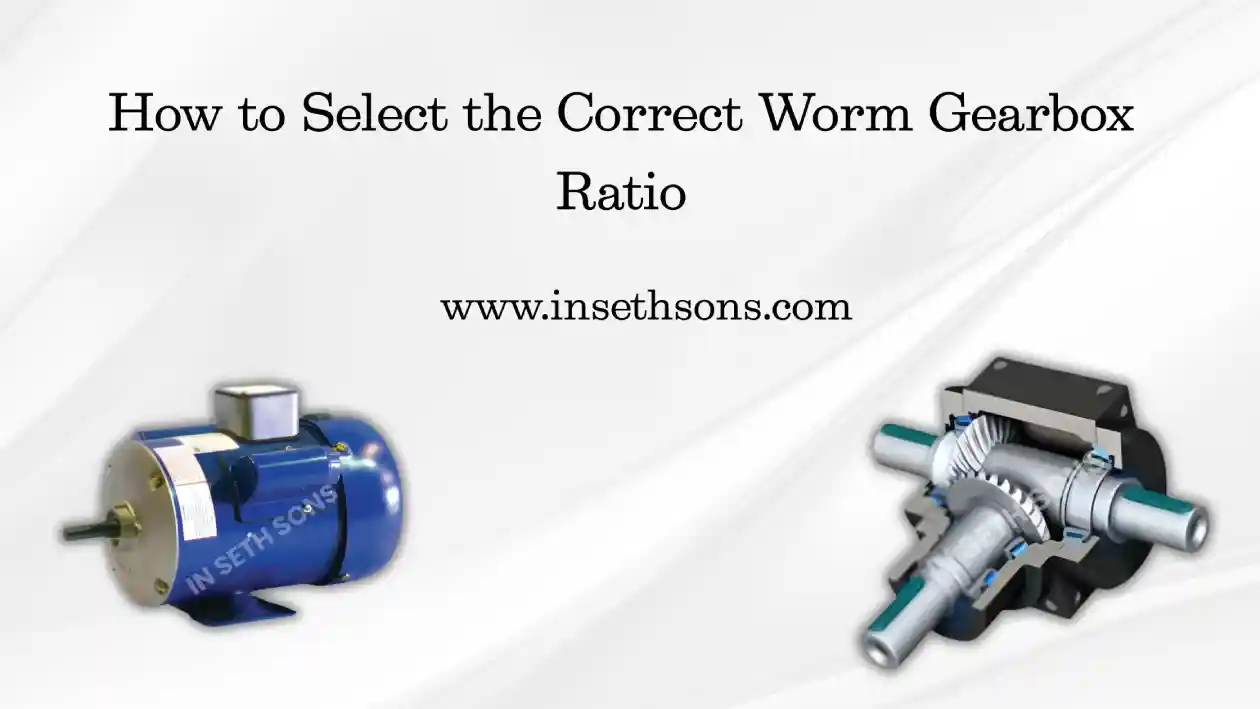
Worm gearboxes are commonly used in industrial machinery where controlled speed reduction and dependable power transmission are required. They are found in applications such as conveyors, material-handling equipment, packaging machinery, processing machines, manufacturing systems, and various types of industrial automation.
However, selecting a worm gearbox is not simply about choosing a model with the required motor capacity. The gearbox ratio also plays an important role in determining how the motor’s power is transferred to the machine.
Choosing the wrong ratio can result in a machine running faster or slower than required, insufficient torque at the output, excessive heat, or inefficient operation.
For industrial buyers, understanding the application and consulting an experienced Worm Gearbox Supplier can make the selection process much easier.
What Does a Worm Gearbox Ratio Mean?
The gearbox ratio essentially determines how much the motor’s speed is reduced before the power reaches the driven equipment.
A motor may operate at a relatively high speed, while the machinery connected to it may require much slower and more controlled movement. The worm gearbox provides this reduction.
For example, a conveyor, mixer, or material-handling machine may require a much lower operating speed than the motor itself. The appropriate gearbox ratio helps achieve that required speed while providing the torque needed by the application.
The exact ratio should always be selected according to the gearbox manufacturer’s specifications and the requirements of the machinery.
1. Start With the Machine Requirement
The best place to begin is not the gearbox catalogue. It is the machine.
Before selecting a gearbox, understand what the machine actually needs.
Consider how quickly the equipment needs to operate, how much load it handles, how frequently it starts and stops, and whether it operates continuously or intermittently.
For example, a conveyor transporting products continuously may have very different gearbox requirements from a machine that repeatedly starts, stops, reverses, and handles heavy loads.
Understanding the application first makes gearbox selection much more accurate.
2. Check the Motor Specifications
The motor and gearbox need to work together as a complete drive system.
Important motor details include its power rating, operating speed, voltage, phase, mounting arrangement, and duty rating.
If the gearbox is being purchased as a replacement, the existing motor nameplate can provide useful information.
Buyers should share the motor’s technical details with the supplier instead of selecting a gearbox based only on the motor’s horsepower.
3. Determine the Required Machine Speed
The required output speed is one of the most important considerations when selecting the gearbox ratio.
Different machines require different operating speeds.
A slow-moving conveyor, for example, may need a high reduction ratio, while another industrial machine may require a faster output.
The supplier should know the required machine speed so that suitable gearbox ratios can be evaluated.
It is also important to consider whether the machine can operate across a range of speeds or requires one specific operating speed.
4. Consider the Load Being Handled
The type of load can have a major influence on gearbox selection.
A machine handling a light and consistent load may have relatively predictable operating requirements. Heavy machinery, on the other hand, may experience higher starting loads and greater mechanical stress.
Industrial applications can involve:
- Continuous loads
- Variable loads
- Heavy loads
- Shock loads
- Frequent starting and stopping
- Frequent reversing
The gearbox ratio should therefore be considered together with the required torque and gearbox capacity.
5. Think About Starting Conditions
The conditions under which a machine starts can be very different from its normal operating conditions.
A conveyor carrying material, a mixer containing a heavy batch, or a material-handling system starting under load may require considerably more torque during startup.
This is why industrial buyers should tell the Worm Gearbox Supplier whether the machine starts empty, partially loaded, or fully loaded.
Frequent starts and stops should also be mentioned because they can influence gearbox selection and service requirements.
6. Consider Continuous or Intermittent Operation
How long the gearbox operates each day is another important factor.
A gearbox used for occasional machinery operation may have different requirements from one working continuously across several shifts.
Continuous industrial operation can place greater thermal and mechanical demands on the gearbox.
When requesting a quotation, buyers should provide information about:
- Daily operating hours
- Number of shifts
- Starts and stops
- Load pattern
- Ambient conditions
This helps the supplier evaluate whether the selected gearbox is appropriate for the intended duty.
7. Don’t Select the Ratio in Isolation
One of the most common mistakes is choosing a gearbox based only on the desired ratio.
The ratio may appear correct, but the gearbox could still be unsuitable because of its torque capacity, thermal rating, motor compatibility, mounting arrangement, or operating conditions.
A proper selection should consider the complete system.
The motor, gearbox, load, speed, duty cycle, and driven equipment all need to be evaluated together.
8. Consider Space and Mounting Requirements
Industrial machinery often has limited installation space.
The selected gearbox needs to fit into the available area without creating problems with surrounding components.
Check the required:
- Mounting arrangement
- Shaft position
- Output shaft dimensions
- Centre height
- Coupling
- Installation orientation
- Available clearance
This is especially important when replacing an existing gearbox.
Providing photographs and dimensions of the current installation can help the supplier identify suitable options.
9. Consider the Working Environment
The operating environment can also influence gearbox selection.
A gearbox installed inside a clean manufacturing facility may face very different conditions from one working outdoors or in a dusty production area.
Consider whether the equipment will be exposed to:
- Dust
- Moisture
- High temperatures
- Outdoor conditions
- Chemicals
- Continuous production heat
The gearbox, lubricant, seals, and installation arrangement should be appropriate for the actual working environment.
10. Think About Efficiency and Operating Costs
The initial purchase price is not the only cost associated with a gearbox.
Industrial equipment may operate for thousands of hours over its service life. Therefore, buyers should consider efficiency, maintenance requirements, expected service life, and downtime alongside the purchase price.
A gearbox that is properly selected for the application can contribute to more reliable operation and reduce avoidable maintenance problems.
For businesses running multiple production lines, these considerations can have a meaningful impact on long-term operating costs.
11. Consider Future Requirements
Industrial machinery may eventually be modified or operated under different conditions.
If a business expects production capacity to increase, load requirements to change, or machinery to operate for longer hours, these possibilities should be discussed before selecting the gearbox.
However, unnecessarily oversizing the gearbox is not always the best solution.
The objective should be to select a model that provides appropriate capacity for the actual application while allowing reasonable operating margins.
Common Mistakes When Selecting a Worm Gearbox Ratio
Choosing Based Only on Motor Power
A motor’s power rating does not provide enough information to select the gearbox ratio.
Ignoring the Required Output Speed
The gearbox should be selected according to the actual speed required by the machine.
Overlooking Starting Loads
Heavy starting conditions can significantly affect gearbox requirements.
Ignoring Operating Hours
A gearbox used continuously may require different consideration from one used intermittently.
Focusing Only on Purchase Price
A low-cost gearbox may not provide good value if it is unsuitable for the application.
Forgetting Installation Requirements
The gearbox must fit the machine mechanically as well as meet its performance requirements.
What Information Should You Give a Worm Gearbox Supplier?
When contacting a supplier, providing complete information can make the selection process much easier.
Ideally, provide the motor nameplate details along with information about the machine.
Tell the supplier:
- What type of machine the gearbox will operate
- Required output speed
- Motor power and RPM
- Approximate load
- Operating hours
- Starting conditions
- Number of starts and stops
- Mounting requirements
- Available installation space
- Working environment
- Whether the gearbox is a new installation or replacement
The more accurately the application is described, the easier it is for the supplier to recommend suitable options.
Why Choose an Experienced Worm Gearbox Supplier?
An experienced Worm Gearbox Supplier can provide more than a product catalogue.
Industrial buyers may need assistance with product selection, motor compatibility, gearbox sizing, replacement identification, mounting, spare parts, and maintenance requirements.
This support can be particularly useful for factories, OEMs, machinery manufacturers, contractors, and businesses managing multiple production systems.
Rather than selecting a gearbox based solely on a standard specification, buyers should work with a supplier that understands the application and can provide appropriate technical information.
I.N. Seth & Sons for Worm Gearbox Requirements
I.N. Seth & Sons is a Delhi-based supplier of industrial motors, geared motors, worm geared motors, gearboxes, and related power-transmission products.
For businesses looking for a worm gearbox, the company can be approached with details about the motor, machinery, required speed, load, operating conditions, and installation requirements.
Providing complete application information can help buyers identify a gearbox that is appropriate for their specific machinery rather than simply choosing a model based on size or price.
Conclusion
Selecting the correct worm gearbox ratio requires an understanding of the machine, motor, required operating speed, load, starting conditions, duty cycle, installation arrangement, and working environment.
The ratio should not be considered separately from the gearbox’s torque capacity, thermal performance, and compatibility with the motor.
For industrial buyers, the best approach is to provide complete machinery details to an experienced Worm Gearbox Supplier and compare suitable options based on the application’s actual requirements.
A properly selected worm gearbox can provide reliable speed reduction and power transmission while supporting efficient and consistent machine operation. The right selection at the purchasing stage can also help reduce avoidable maintenance issues and downtime over the equipment’s working life.