

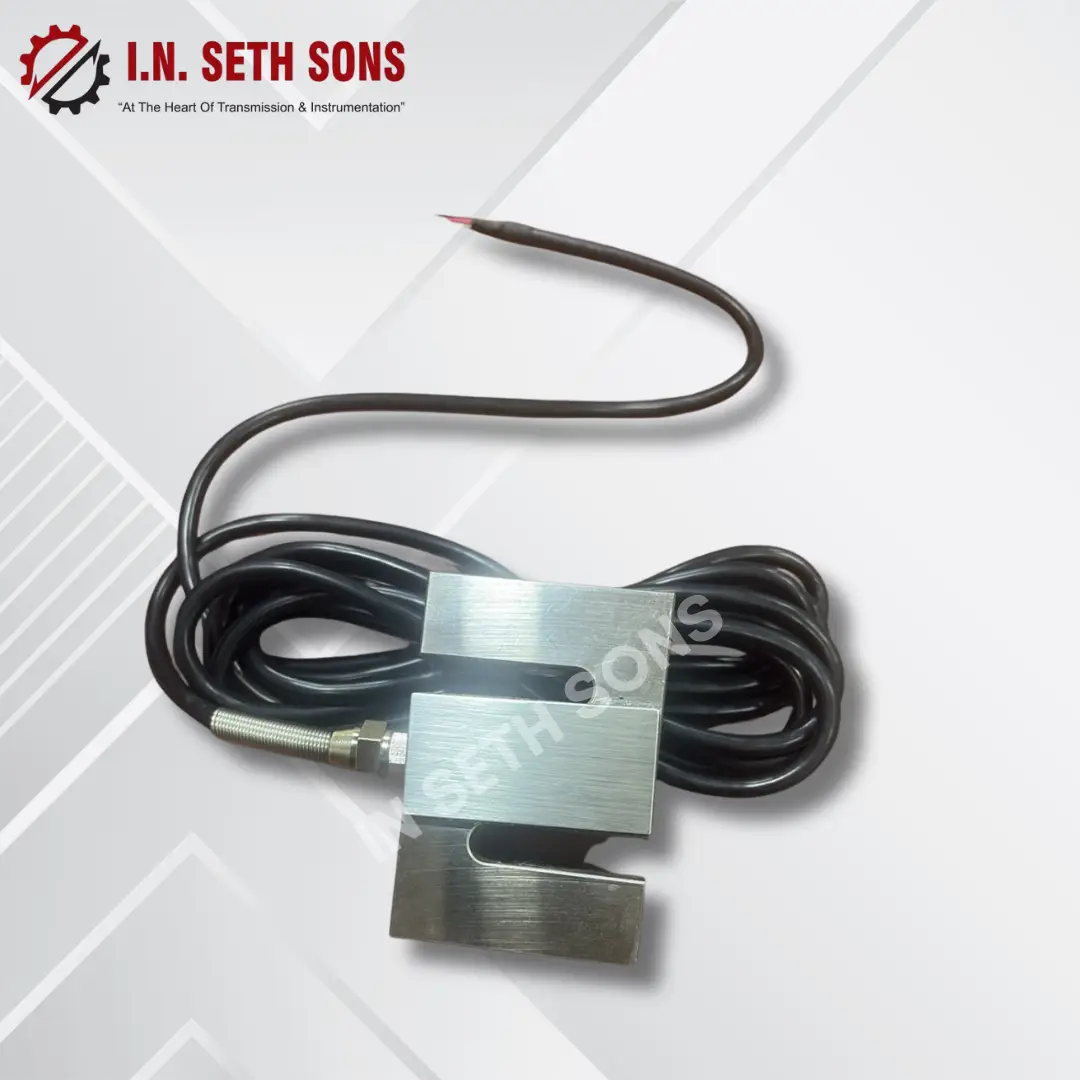
| Specification | Details |
|---|---|
| Stroke Length | 5mm to 300mm |
| Transducer Type | Linear Transducer |
| Mounting Type | Screw |
| Output Type | Resistive |
| Output Signal | Resistive/Voltage/Current |
| Accuracy | ±0.1% |
| Linearity | 0.15% |
S-Type Load Cell
An S-type load cell is a force transducer shaped like the letter “S”. It operates using strain gauge technology and is designed to measure axial loads in both directions—tension (pulling) and compression (pushing).
Thanks to its symmetric design, it offers excellent mechanical balance, high linearity, and easy installation.
2. Typical Applications of S-Type Load Cells
S-type load cells are favored in systems that require:
- Mid- to high-capacity load measurement
- Bidirectional force sensing
- Robust mechanical stability
Common Use Cases:
| Application | Description |
|---|---|
| Hopper & Tank Weighing | Measure the contents of storage tanks or silos in real-time |
| Material Testing Machines | Used in tensile and compression test rigs |
| Suspended Weighing Systems | Hanging scales, crane load cells, or livestock weighing |
| Packaging Equipment | Control fill levels during batching or dosing operations |
| Tension Control Systems | Monitor cable, web, or belt tension in production lines |
3. Advantages of S-Type Load Cells
- Dual-direction capability: Measures both tension and compression
- Compact form: Fits easily into tight mechanical structures
- High accuracy: Typical non-linearity ≤ ±0.03% F.S.
- Multiple capacities: Available from a few kilograms up to several tons
- Easy to install: With threaded holes or rod ends for direct force coupling
- Cost-effective: Excellent performance-to-price ratio for general industrial use
4. Selection Tips: How to Choose the Right One
- Rated Load Capacity – Choose a sensor with a nominal load slightly higher than your maximum applied force. A safety margin of 120–150% is recommended.
- Signal Output – Most S-type load cells provide a millivolt-per-volt (mV/V) analog signal. Choose signal conditioning electronics, such as an amplifier or transmitter, accordingly.
- Mounting Orientation – Proper alignment is critical. Misaligned force can lead to errors or mechanical failure.
- Environmental Protection – Look for IP67-rated models if used in dusty or wet environments. For food and pharmaceutical applications, stainless steel construction may be required.
- Cable Length and Shielding – Use shielded cables for long-distance transmission to reduce signal noise.
5. Calibration and Maintenance
- Initial Calibration: Essential for integrating the load cell into your system.
- Periodic Recalibration: Depending on usage, recalibrate every 6–12 months.
- Mechanical Inspection: Check for overload marks, loose fittings, or cable wear.