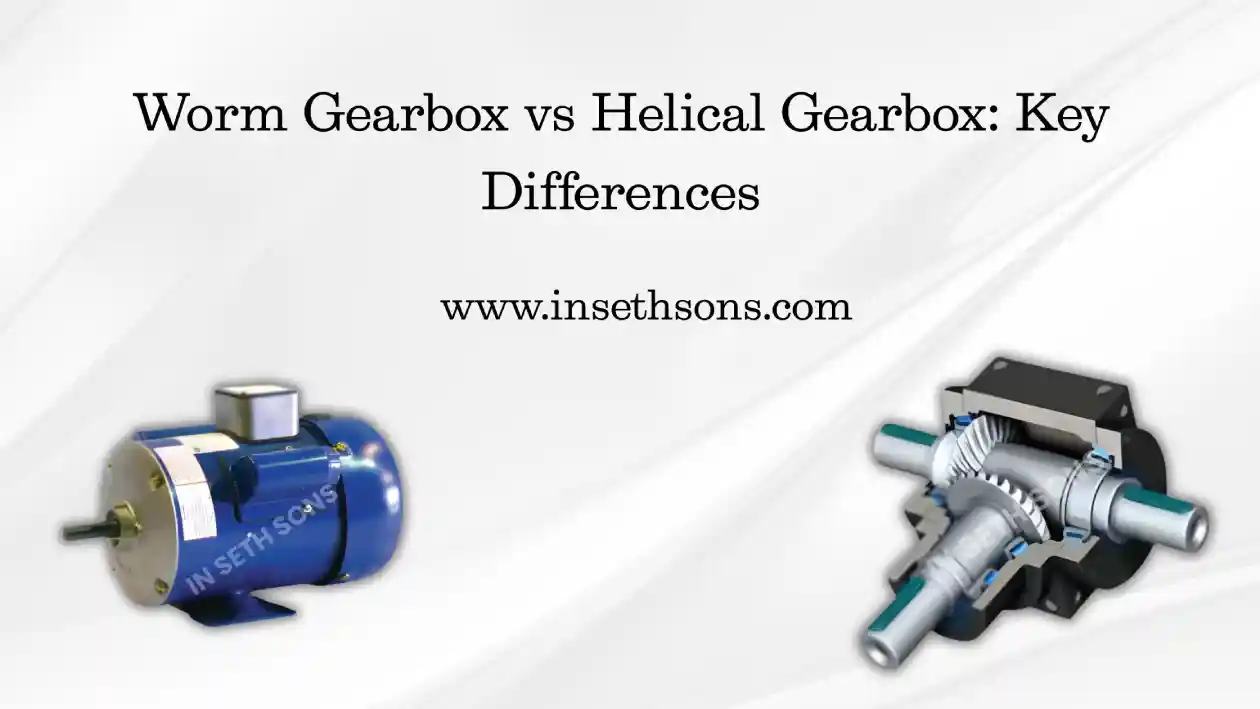
Gearboxes play an important role in industrial machinery by controlling speed and transmitting power from the motor to the driven equipment. Among the many gearbox designs available, worm gearboxes and helical gearboxes are commonly considered for industrial applications.
Although both can be used for speed reduction, their construction and operating characteristics are different. These differences can influence efficiency, torque transmission, heat generation, maintenance requirements, installation space, and overall suitability for a particular machine.
For industrial buyers, choosing between a worm gearbox and a helical gearbox should therefore depend on the actual application rather than simply comparing their purchase prices.
What Is a Worm Gearbox?
A worm gearbox uses a worm shaft working with a worm wheel to reduce speed and transfer power.
Its compact construction makes it useful where space is limited and substantial speed reduction is required. Worm gearboxes are commonly found in conveyors, material-handling equipment, packaging machinery, lifting-related applications, processing equipment, and various industrial machines.
They are particularly useful where a simple and compact reduction arrangement is required.
What Is a Helical Gearbox?
A helical gearbox uses gears with angled teeth that engage progressively. This design allows power to be transferred smoothly between the gears.
Helical gearboxes are commonly used in industrial machinery where efficiency, continuous operation, and higher power transmission are important considerations.
They can be found in conveyors, production machinery, material-handling systems, pumps, mixers, processing equipment, and other heavy-duty industrial applications.
Worm Gearbox vs Helical Gearbox: Main Differences
The biggest differences between these two gearbox types relate to their gear construction, efficiency, reduction capability, operating temperature, maintenance, and application suitability.
1. Efficiency
Efficiency is one of the most important differences between worm and helical gearboxes.
Worm gearboxes involve sliding contact between the worm and worm wheel. This can result in greater friction and heat generation, particularly at higher reduction ratios.
Helical gears primarily use rolling and sliding contact, which can provide higher efficiency in many industrial applications.
For machinery operating continuously for long periods, efficiency can become an important factor because energy losses accumulate over time.
However, the actual efficiency should always be checked from the manufacturer’s technical specifications for the selected gearbox and ratio.
2. Speed Reduction
Worm gearboxes are often selected when substantial speed reduction is required within a compact arrangement.
This makes them useful for machinery where the motor operates at a relatively high speed but the driven equipment needs significantly slower movement.
Helical gearboxes can also provide speed reduction, but applications requiring very high reduction may use multiple stages or a different gearbox arrangement.
The appropriate choice depends on the machine’s required output speed and torque.
3. Torque Requirements
Both gearbox types can be designed for industrial torque requirements, but the appropriate selection depends on the specific application.
A worm gearbox can provide substantial reduction and is suitable for many moderate-duty industrial applications.
Helical gearboxes are often preferred for applications requiring efficient power transmission and higher continuous-duty performance.
The gearbox should always be selected according to the required output torque rather than simply the motor’s horsepower.
4. Heat Generation
Heat is an important consideration in industrial gearbox selection.
Because worm gearboxes can experience greater sliding friction, they may generate more heat than a comparable helical arrangement.
This becomes particularly important in continuous-duty applications or environments with high ambient temperatures.
Helical gearboxes can offer higher efficiency, which can reduce energy losses and associated heat generation.
The gearbox’s thermal rating should therefore be checked when selecting equipment for continuous industrial operation.
5. Compact Design
One of the major advantages of worm gearboxes is their compact arrangement, particularly when substantial speed reduction is required.
This can be useful where machinery has limited installation space.
Helical gearboxes can also be compact, but the overall dimensions depend on the number of stages, required reduction, power rating, and gearbox configuration.
For space-constrained machinery, the physical dimensions should be compared before purchase.
6. Maintenance Requirements
Both gearbox types require proper lubrication, installation, alignment, and periodic inspection.
Worm gearboxes should be monitored for lubricant condition, temperature, gear wear, leakage, and bearing condition.
Helical gearboxes also require appropriate lubrication and inspection of gears, bearings, seals, and mounting arrangements.
The exact maintenance requirements depend on the gearbox model and manufacturer.
Following the manufacturer’s maintenance schedule is more important than assuming that one gearbox type requires no maintenance.
7. Operating Life
Gearbox service life depends on several factors, including correct selection, load, lubrication, operating temperature, installation quality, maintenance, and duty cycle.
A properly selected worm gearbox can provide reliable service in suitable applications.
Similarly, a properly sized helical gearbox can provide long-term performance in continuous industrial environments.
The quality of the gearbox and its suitability for the application should therefore be considered alongside its basic design type.
8. Application Suitability
Worm gearboxes are often considered for applications where compactness and significant speed reduction are important.
They may be suitable for:
- Conveyors
- Packaging equipment
- Material-handling machinery
- Processing equipment
- Industrial automation
- Compact machinery
Helical gearboxes may be preferred where higher efficiency and continuous power transmission are important.
They are commonly used in:
- Heavy-duty conveyors
- Production machinery
- Industrial processing equipment
- Material-handling systems
- Manufacturing lines
- Continuous-duty drives
The application requirements should determine the final choice.
9. Initial Purchase Cost
Worm gearboxes can be an economical choice for many industrial applications, particularly where compact high reduction is required.
Helical gearboxes may have a higher initial cost depending on their design and capacity.
However, purchase price should not be the only consideration.
For equipment operating continuously, factors such as energy consumption, maintenance, service life, and downtime can have a greater impact on the total cost of ownership.
10. Which Gearbox Is Better for Continuous Operation?
For long-running industrial applications, efficiency and thermal performance become particularly important.
A helical gearbox may be preferable where high efficiency and continuous power transmission are major priorities.
A worm gearbox can still be appropriate for continuous applications when it is correctly selected and operated within its thermal and mechanical limits.
The decision should be based on the manufacturer’s ratings and the actual operating conditions.
Worm Gearbox or Helical Gearbox: Which Should You Choose?
There is no universal answer.
A worm gearbox may be a better choice when the application requires compact construction, substantial speed reduction, and a cost-effective solution for the required load.
A helical gearbox may be more suitable when efficiency, continuous operation, and higher power transmission performance are priorities.
The right choice depends on the machine rather than the gearbox type alone.
Questions to Ask Before Buying
Before purchasing either type of gearbox, industrial buyers should understand the complete application.
Consider the motor’s power and speed, required machine speed, output torque, operating hours, starting conditions, load characteristics, installation space, and working environment.
It is also important to check the manufacturer’s technical specifications for efficiency, thermal capacity, permissible loads, lubrication requirements, and maintenance intervals.
Why Work With an Experienced Gearbox Supplier?
Choosing between a worm and helical gearbox can become easier when the supplier understands the machinery application.
A professional Worm Gearbox Supplier can help assess the motor, load, speed requirements, operating conditions, and installation arrangement before recommending a suitable product.
This is particularly useful for manufacturers, factories, OEMs, contractors, and businesses replacing existing gearboxes.
I.N. Seth & Sons for Industrial Gearbox Requirements
I.N. Seth & Sons is a Delhi-based supplier of industrial motors, geared motors, worm geared motors, gearboxes, and related power-transmission products.
For businesses comparing gearbox options, providing complete application details can help determine whether a worm gearbox or another gearbox configuration is better suited to the machinery.
Buyers should compare the current technical specifications, ratings, efficiency, dimensions, and application suitability of the specific gearbox models before making a final purchase decision.
Conclusion
Worm and helical gearboxes both have an important role in industrial power transmission, but they are suited to different operating requirements.
Worm gearboxes are often attractive because of their compact design and ability to provide substantial speed reduction. Helical gearboxes are commonly considered when efficiency and continuous power transmission are higher priorities.
The best choice depends on the application’s required speed, torque, operating hours, load characteristics, available space, efficiency expectations, and budget.
Rather than choosing a gearbox based only on price or general specifications, industrial buyers should discuss their actual machinery requirements with an experienced Worm Gearbox Supplier and compare the available options using the manufacturer’s technical data.