Introduction
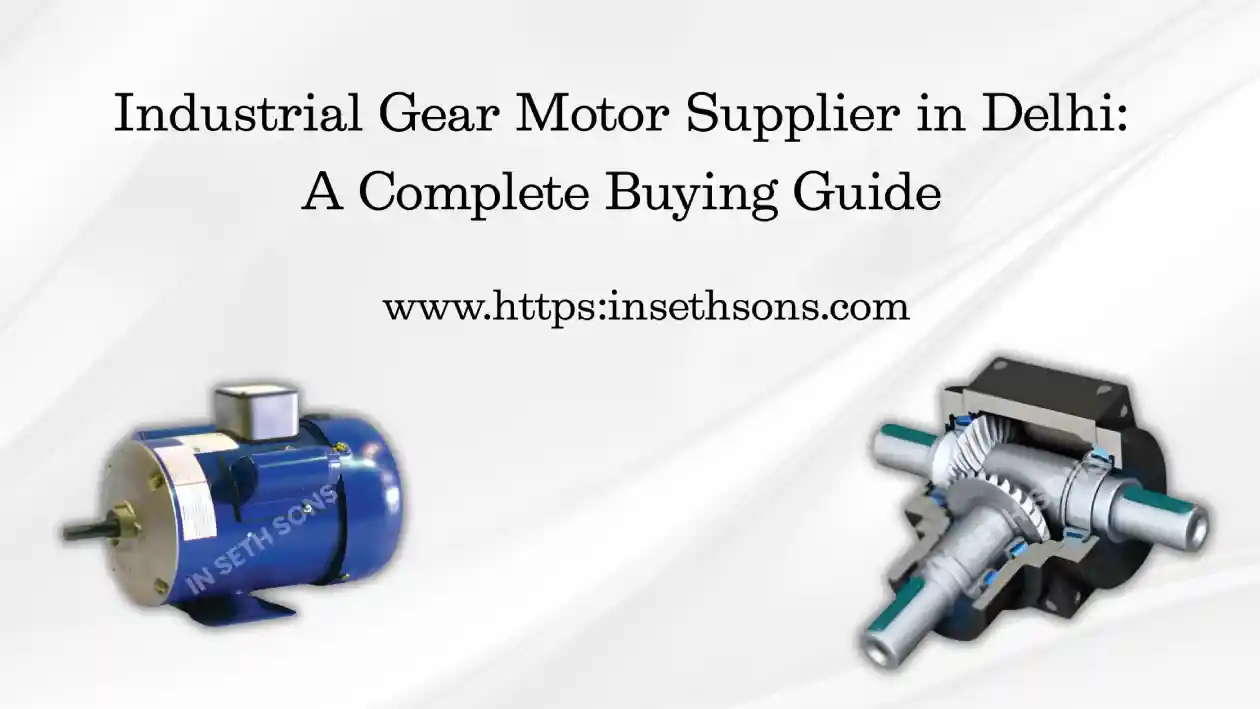
Industrial gear motors are an important part of many machinery and power-transmission systems. By combining an electric motor with a gearbox, a gear motor can provide controlled output speed and increased torque in a compact drive arrangement.
They are commonly used in conveyors, material-handling systems, packaging machinery, processing equipment, automation systems, manufacturing machinery, and other industrial applications.
However, choosing the right gear motor requires more than selecting a motor based on horsepower. Buyers need to consider output torque, speed, gear ratio, duty cycle, mounting arrangement, load characteristics, operating environment, and motor compatibility.
For businesses searching for an Industrial Gear Motor Supplier in Delhi, I.N. Seth & Sons provides industrial motor and geared-motor options and lists products from brands and categories including Rotomotive, Remi, premium transmission gear motors and gearboxes, worm geared motors, and other industrial motors.
What Is an Industrial Gear Motor?
An industrial gear motor combines:
Electric Motor + Gearbox = Controlled Mechanical Output
The motor generates rotational power, while the gearbox reduces speed and changes the available output torque.
Depending on the gearbox design and ratio, a gear motor can provide:
- Lower output speed
- Higher output torque
- Compact power transmission
- Controlled machine movement
- Reliable continuous operation for suitable applications
The appropriate configuration depends on the machinery and operating conditions.
1. Determine the Required Motor Power
The first step is to determine the power required by the machine.
Industrial gear motors may be available in different power ratings, so buyers should consider:
- Required load
- Starting load
- Continuous load
- Peak load
- Operating hours
- Machine speed
- Acceleration requirements
Selecting a motor solely based on the existing motor’s horsepower can be risky if the new machine has different load characteristics.
2. Calculate the Required Output Torque
Torque is one of the most important specifications when selecting a gear motor.
The gearbox should be capable of delivering the required output torque without being continuously overloaded.
Consider:
- Normal operating torque
- Starting torque
- Peak torque
- Shock loading
- Load variation
- Duty cycle
An undersized gear motor may experience overheating, excessive wear, or premature failure.
3. Choose the Correct Output Speed
Different machines operate at different speeds.
For example, a conveyor may require a relatively slow controlled output while the motor itself operates at a much higher RPM.
Before contacting a supplier, determine:
Motor RPM → Gear Ratio → Required Output RPM
The supplier can then help identify an appropriate gear motor configuration.
4. Select the Appropriate Gear Ratio
Gear ratio determines the degree of speed reduction provided by the gearbox.
A higher reduction ratio generally produces lower output speed and, subject to the gearbox’s rating and efficiency, greater available output torque.
The correct ratio depends on:
- Input motor speed
- Required output speed
- Load
- Machine cycle
- Torque requirement
A gearbox should not be selected solely because it has the desired ratio; its torque and power rating must also be suitable.
5. Consider the Type of Gear Motor
Different gearbox designs suit different applications.
Worm Gear Motors
Worm gear systems are commonly selected where compact construction and substantial speed reduction are important.
Helical Gear Motors
Helical gearing can offer efficient power transmission and is widely used in industrial machinery.
Helical-Bevel Gear Motors
These can be useful when higher efficiency and specific mounting arrangements are required.
Other Geared Motor Designs
Spur, planetary, and specialized transmission systems may be appropriate for particular machinery.
The “best” gearbox type depends on the application’s speed, torque, efficiency, space, and duty requirements.
6. Check the Mounting Arrangement
A gear motor must fit the machine mechanically.
Check:
- Foot mounting
- Flange mounting
- Shaft orientation
- Output shaft position
- Mounting dimensions
- Centre height
- Available installation space
If replacing an existing gear motor, providing the supplier with the old motor’s model number, dimensions, and photographs can help with identification.
7. Check the Output Shaft
The output shaft connects the gear motor to the driven machinery.
Important specifications include:
- Shaft diameter
- Shaft length
- Solid or hollow shaft
- Keyway dimensions
- Shaft orientation
- Coupling requirements
Even a correctly rated gear motor may not be suitable if the output shaft cannot be integrated into the machine.
8. Consider the Duty Cycle
Industrial machinery may operate continuously, intermittently, or with frequent starts and stops.
Tell your supplier whether the motor will operate:
- A few hours per day
- One production shift
- Multiple shifts
- Continuously
- With frequent starts and stops
Duty cycle affects motor selection, thermal performance, and gearbox sizing.
9. Evaluate the Load Characteristics
Not all loads behave in the same way.
A conveyor, mixer, crusher, pump, and lifting system can place very different demands on a gear motor.
Consider whether the load is:
- Constant
- Variable
- Shock-loaded
- High-inertia
- Frequently reversing
- Starting under load
Providing this information to the supplier can improve product selection.
10. Check Motor Voltage and Phase
Electrical compatibility is essential.
Before purchasing, confirm:
- Supply voltage
- Single-phase or three-phase operation
- Frequency
- Rated current
- Motor speed
- Starting method
- Control requirements
The motor should be compatible with the plant’s electrical supply and control system.
11. Consider Efficiency
Efficiency becomes increasingly important when gear motors operate for long periods.
A more efficient drive can help reduce energy losses and operating costs.
When comparing products, consider:
- Motor efficiency
- Gearbox efficiency
- Operating load
- Operating hours
- Energy costs
The cheapest motor at purchase may not necessarily have the lowest lifetime operating cost.
12. Check the Operating Environment
Industrial gear motors can operate in a wide range of environments, but the environment must be considered during selection.
Tell the supplier if the motor will operate in:
- Dusty areas
- Wet environments
- High temperatures
- Outdoor installations
- Chemical-processing areas
- Washdown environments
- Areas with significant vibration
The required enclosure, sealing, protection, and materials can depend on these conditions.
13. Ask About Maintenance Requirements
Before purchasing, understand the maintenance requirements of the gear motor.
Ask about:
- Lubrication
- Oil or grease requirements
- Inspection intervals
- Bearing maintenance
- Seal replacement
- Motor servicing
- Gearbox inspection
Following the manufacturer’s maintenance schedule can help maintain performance and service life.
14. Check Spare-Parts Availability
Spare-parts availability is especially important for production machinery.
Ask whether the supplier can provide or source:
- Bearings
- Oil seals
- Gear components
- Couplings
- Motors
- Brake components
- Replacement shafts
- Lubricants
A reliable supply chain can reduce downtime when maintenance is required.
15. Evaluate the Supplier’s Technical Support
A good Industrial Gear Motor Supplier in Delhi should ideally do more than provide a catalogue and quotation.
Technical support can help with:
- Motor selection
- Gear ratio selection
- Torque requirements
- Mounting
- Replacement identification
- Installation
- Maintenance
- Troubleshooting
This becomes particularly valuable for OEMs and industrial plants with specialized machinery.
Why Choose I.N. Seth & Sons?
I.N. Seth & Sons is based at M-145, Street No. 9, Shastri Nagar, Delhi-110052 and identifies itself as an industrial motor and worm gearbox manufacturer and supplier. Its published product range includes 2000 RPM worm geared motors, Lawkim motors, Crompton Greaves electric motors, Marathon motors, Motovario products, Havells motors, Rotomag PMDC motors, servo motors, premium transmission gear motors and gearboxes, and other industrial motor products.
The company’s published information also states that it provides application assistance based on factors such as load, speed, torque, and operational requirements, along with installation, maintenance, and troubleshooting support.
Common Mistakes When Buying a Gear Motor
Choosing Only by Motor HP
Two motors with the same power rating can perform differently depending on speed, torque, duty cycle, and gearbox ratio.
Ignoring Starting Torque
Some machines require significantly more torque during startup than during normal operation.
Selecting the Wrong Gear Ratio
Incorrect output speed can affect the entire production process.
Ignoring Mounting Dimensions
The gear motor must physically fit the machine.
Not Considering the Environment
Dust, moisture, heat, and chemicals can affect motor and gearbox selection.
Buying Without Checking Spare Parts
A low purchase price can become expensive if replacement components are difficult to obtain.
Industrial Applications of Gear Motors
Industrial gear motors can be used in many types of machinery, including:
- Conveyors
- Packaging machines
- Material-handling systems
- Processing machinery
- Manufacturing equipment
- Textile machinery
- Food-processing equipment
- Automation systems
- Mixers
- Industrial production lines
- OEM machinery
I.N. Seth & Sons states that its industrial motor and gearbox solutions serve sectors including manufacturing, engineering/OEMs, food processing, packaging, material handling, and other industrial applications.
Final Thoughts
Selecting an Industrial Gear Motor Supplier in Delhi should involve more than comparing prices. Buyers should evaluate motor power, output torque, gear ratio, output speed, duty cycle, load characteristics, mounting dimensions, electrical specifications, operating environment, efficiency, maintenance, spare parts, and technical support.
I.N. Seth & Sons offers a range of industrial motors and geared-motor solutions from its Delhi operation, making it an option for businesses evaluating industrial drive requirements.
For the best product selection, provide the supplier with complete machinery details and request the technical datasheet, final specification, warranty terms, delivery details, and quotation for the exact gear motor before placing an order.