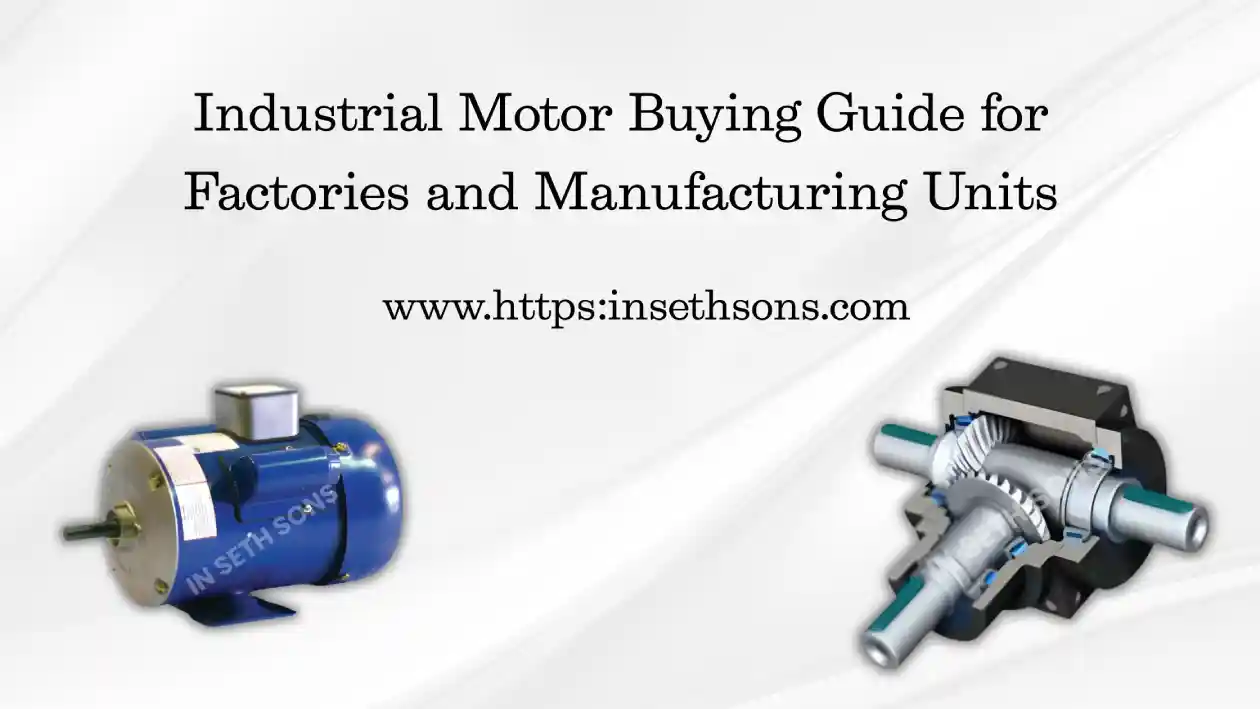
Industrial motors are essential to the operation of modern factories and manufacturing units. They provide the mechanical power required to operate conveyors, pumps, compressors, fans, mixers, processing machinery, material-handling equipment, machine tools, and many other production systems.
Because motors can operate for long hours and may be connected to critical production equipment, choosing the right model is more important than simply selecting one with a particular power rating.
An incorrectly selected motor can lead to overheating, inefficient operation, frequent maintenance, premature failure, or production interruptions. On the other hand, a motor properly matched to the machine can support reliable operation and better long-term operating performance.
For factories planning a new installation, machinery upgrade, or motor replacement, the following factors should be considered before making a purchase.
Start With the Actual Machine Requirement
The first step in buying an industrial motor is understanding the equipment that the motor will operate.
Factories use motors for very different applications. A motor driving a conveyor does not necessarily have the same requirements as one operating a pump, compressor, fan, mixer, crusher, or production machine.
The application determines the type of load, required speed, starting conditions, operating hours, and environmental requirements.
Instead of starting with a motor catalogue, purchasing teams should first gather information about the machinery and its operating conditions.
This helps the supplier recommend a motor based on the actual application rather than simply matching the power of an existing unit.
Consider the Required Motor Power
Motor power is one of the first specifications buyers normally consider, but it should not be the only one.
The motor should have sufficient capacity to operate the connected machinery under its normal working conditions without being unnecessarily oversized.
An undersized motor may struggle under load and can experience excessive heating or repeated overload conditions. An oversized motor can also be inefficient when it consistently operates well below its intended loading.
For this reason, factories should consider the actual operating load rather than selecting a motor simply because it has a larger power rating.
When replacing an existing motor, the old motor’s rating is useful information, but it should not automatically determine the new motor specification. Production conditions may have changed since the original motor was installed.
Check the Required Operating Speed
Motor speed should match the requirements of the machinery and the overall drive system.
Different production machines require different operating speeds. Some equipment can operate directly from the motor, while other machines require a gearbox or variable speed drive to achieve the desired operating conditions.
If the application uses a gearbox, the motor and gearbox should be considered together. The motor’s speed must be compatible with the selected gearbox and the required output speed of the machinery.
For replacement applications, checking the existing motor nameplate and gearbox information can help establish the original configuration.
Understand the Load Characteristics
The type of load is an important part of industrial motor selection.
Some machines operate with relatively stable loads, while others experience significant changes during production.
A conveyor transporting a consistent product load may have different requirements from a crusher, mixer, compressor, or machine that experiences heavy starting resistance.
Factories should consider whether the application involves a constant load, variable load, heavy starting load, frequent acceleration, or sudden changes in demand.
Providing this information to the Industrial Motor Supplier can help with more appropriate motor selection.
Consider Starting Conditions
Starting conditions can place significant demands on an industrial motor.
Some machines start with little resistance, while others must begin operation while already carrying a substantial load.
Conveyors, compressors, mixers, pumps, and material-processing equipment can all have different starting characteristics.
Frequent starting and stopping can also affect motor selection because repeated starts can create additional thermal and mechanical demands.
If a motor will be controlled by a starter or VFD, the control system should also be considered during the selection process.
Pay Attention to Duty Cycle
Factories need to consider how long and how frequently the motor will operate.
A motor running continuously throughout multiple production shifts has different requirements from one that operates intermittently.
Continuous-duty applications require appropriate attention to thermal performance, cooling, efficiency, and overall motor construction.
The motor’s duty classification should therefore be checked against the actual production schedule.
This is particularly important for manufacturing units where motors may operate for many hours every day.
Choose the Right Motor for the Factory Environment
The operating environment can have a major effect on motor performance and service life.
A motor installed inside a clean and dry production room may not require the same protection as one operating in a dusty, wet, hot, or chemically exposed area.
Factories should consider whether the motor will be exposed to:
- Dust and airborne particles
- Moisture
- Water or washdown
- High temperatures
- Chemicals
- Outdoor conditions
- Restricted ventilation
The motor enclosure should be appropriate for the environment in which it will operate. Industrial motor selection guides commonly distinguish between open construction for clean, protected environments and enclosed designs for broader industrial conditions.
Consider Motor Efficiency
Energy consumption is an important consideration for factories because industrial motors can operate for thousands of hours over their service life.
A motor that is slightly cheaper to purchase may not necessarily be the most economical choice if it consumes more energy during continuous operation.
For heavily used production equipment, buyers should compare available efficiency levels and consider the motor’s expected operating hours.
High-efficiency motor selection is increasingly being treated as a lifecycle-cost decision rather than simply a purchase-price decision.
The appropriate efficiency level should be selected according to the application, operating schedule, applicable requirements, and overall project economics.
Check the Motor Mounting Arrangement
Mechanical compatibility is just as important as electrical compatibility.
Before ordering a replacement motor, factories should check the mounting arrangement, frame dimensions, shaft size, shaft extension, mounting holes, and available installation space.
A motor may have the correct power and speed but still be unsuitable if it cannot be installed correctly on the existing machinery.
For replacement projects, keeping the existing motor nameplate and dimensional information available can help avoid unnecessary installation modifications.
Consider the Electrical Supply
The factory’s electrical system must also be considered.
Important information includes the available voltage, phase, frequency, starting arrangement, and control system.
Factories using three-phase industrial power will typically require motors compatible with their electrical supply and production equipment.
Where a motor is being used with a variable frequency drive, the motor and drive should be evaluated as a combined system rather than independently.
Motor and Gearbox Compatibility
Many manufacturing machines use an industrial motor together with a gearbox.
The gearbox reduces speed and transfers the motor’s power to the machine in a form suitable for the application.
When purchasing a worm geared motor or a separate motor and worm gearbox, buyers should consider motor power, speed, gearbox ratio, output speed, torque, mounting arrangement, and duty cycle together.
This is particularly important for conveyors, material-handling systems, mixers, packaging machinery, and other equipment requiring controlled low-speed movement.
I.N. Seth & Sons lists industrial motors, worm-geared motors, and worm gearboxes among its product offerings.
Think About Maintenance Requirements
A factory motor should be selected with its long-term maintenance requirements in mind.
Regular inspection can help identify problems such as unusual vibration, excessive temperature, bearing noise, damaged cooling components, or electrical issues.
The maintenance team should also have access to appropriate product documentation and manufacturer recommendations.
For production-critical motors, the availability of replacement components and technical assistance can be particularly important.
A motor that is difficult to maintain or replace can create additional downtime when a failure occurs.
Consider Spare Motor Requirements
Factories with critical production equipment may benefit from having suitable replacement motors available for important machines.
This is particularly relevant where a motor failure could stop an entire production line.
The spare motor should be properly identified and stored according to the manufacturer’s recommendations.
Keeping accurate records of motor models, power ratings, speeds, mounting arrangements, and installation locations can also make future replacement easier.
Don’t Buy Only on Price
Price is an important procurement consideration, but it should not be the only deciding factor.
The cheapest motor may not provide the best value if it has unsuitable specifications, lower efficiency, limited support, or poor availability of replacement components.
For factories, the overall cost of ownership can be more important than the initial purchase price.
Energy consumption, maintenance, downtime, service life, and product availability should all be considered when comparing motor options.
What Information Should You Give an Industrial Motor Supplier?
When requesting an industrial motor quotation, providing complete information can significantly improve the selection process.
Ideally, share the existing motor nameplate or equipment specifications along with details about the application.
The supplier should know the required power and speed, electrical supply, load characteristics, operating hours, starting conditions, installation arrangement, and working environment.
For replacement projects, photographs of the existing motor, mounting arrangement, nameplate, and connected equipment can also be useful.
A professional supplier can then compare the requirements against available motor models.
How to Choose the Right Industrial Motor Supplier
The supplier is an important part of the purchasing decision, particularly when a factory requires regular motor replacements or bulk quantities.
Look for a supplier with a broad industrial motor range, application knowledge, reliable product sourcing, technical assistance, and after-sales support.
It is also useful to consider whether the supplier can provide related products such as geared motors, worm gearboxes, drives, and other power-transmission equipment.
For large manufacturing units, consistent supply and technical support can become especially important when multiple machines use similar motor configurations.
I.N. Seth & Sons for Industrial Motor Requirements
I.N. Seth & Sons supplies industrial motors, worm-geared motors, gearboxes, and related power-transmission products for industrial applications. Its product range includes several industrial motor categories and brands, including Lawkim, Crompton Greaves, Marathon, Motovario, Havells, Rotomag, servo motors, and IE2 electric motors.
The company states that it serves sectors including manufacturing, engineering and OEMs, food processing, packaging, material handling, cement and steel, and textile applications.
For a factory purchasing or replacing an industrial motor, providing complete application information allows the supplier to better understand the requirement and identify suitable options.
Industrial Motor Buying Checklist
Before placing an order, factory purchasing and maintenance teams should confirm that the selected motor matches the actual application.
Check the motor’s power, speed, voltage, phase, duty, efficiency, enclosure, mounting arrangement, shaft dimensions, operating environment, and control requirements.
If the motor will be connected to a gearbox or VFD, those components should also be considered as part of the complete drive system.
Finally, confirm product availability, documentation, warranty terms, spare-parts support, and expected delivery time before finalizing the purchase.
Conclusion
Choosing an industrial motor for a factory or manufacturing unit requires more than matching a power rating.
The right motor should be selected according to the machine load, operating speed, starting conditions, duty cycle, electrical supply, environment, efficiency requirements, mounting arrangement, and maintenance needs.
Factories should also consider how the motor will interact with gearboxes, drives, conveyors, pumps, compressors, and other connected equipment.
A properly selected motor can support reliable production and help avoid problems caused by incorrect sizing or unsuitable environmental protection. For high-utilization equipment, efficiency and lifecycle costs should also form part of the purchasing decision.
Working with an experienced Industrial Motor Supplier can make the selection process easier by bringing product knowledge and application understanding into the procurement process.
For factories and manufacturing units, the best motor is not necessarily the most powerful or the least expensive. It is the motor that is properly matched to the machinery, operating conditions, production requirements, and long-term maintenance strategy.